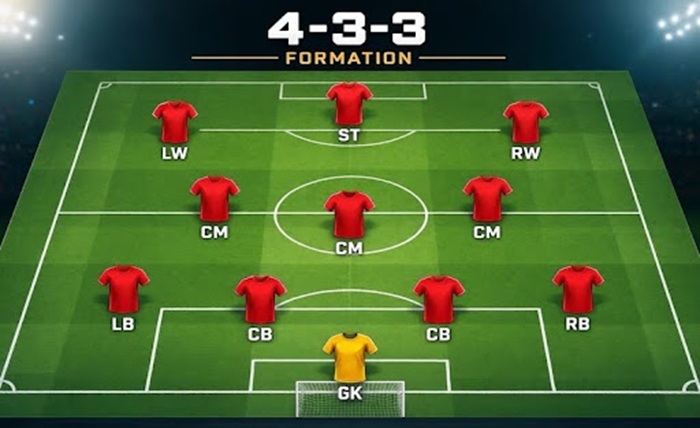
The strongest football formation in the world is always an engaging topic as tactics continue to play an increasingly important role in modern football. From 4-3-3 and 4-2-3-1 to 3-4-3, each setup offers its own advantages depending on the players available and the opponent. Join 90p TV to explore some of the most notable systems and how they operate on the pitch.
What Determines the Strongest Football Formation in the World?
Determining whether a tactical system is strong cannot be based solely on the number of defenders, midfielders, or forwards positioned on the pitch. The value of a formation lies in its ability to control space, create numerical advantages, maintain appropriate distances between players, and transition flexibly between attacking and defensive phases.
An effective system must also suit the qualities of the players. A team with fast wingers can make good use of a 4-3-3, while a squad featuring creative attacking midfielders may be better suited to a 4-2-3-1. When xem tructiepbongda, fans will see that the formation on paper is only the starting point, as players’ actual positions constantly change throughout a match.
4-3-3 – An Effective System for Possession and Pressing
When discussing the strongest football formation in the world, the 4-3-3 is often highly regarded for the balance it provides between the three lines. Three central midfielders can form passing triangles, support ball circulation, and help the team maintain possession. Two wingers stretch the opposition’s defensive structure, while the center forward operates in dangerous areas in front of goal.
Another important advantage of the 4-3-3 is its ability to press immediately after losing possession. The three forwards can apply instant pressure, while the midfield line pushes forward to reduce available space. This helps the team regain possession quickly and limits the opponent’s counterattacking opportunities.
However, this system requires midfielders who are comfortable handling the ball under pressure and full-backs with excellent physical endurance. By following matches on 90Phut TV, viewers can see that the 4-3-3 is frequently transformed into other structures depending on the phase of the game.
4-2-3-1 Creates a Balance Between Attack and Defense
The 4-2-3-1 is one of the most widely used systems because of its ability to provide stability in midfield. The two central midfielders support the defense while also helping move the ball forward. This structure reduces the space in front of the defensive line, particularly when the opponent launches quick counterattacks.
Further forward, the three attacking midfielders can constantly interchange positions to support the center forward. The number 10 usually acts as the link between the lines, while the two wide players exploit space on the flanks or move into central areas. This flexibility makes the 4-2-3-1 suitable for many different styles of play.
3-4-3 and Its Flexible Structural Transformations
The 3-4-3 is considered one of the most tactically versatile formations. When in possession, the two wing-backs can push forward to provide width, while the central midfielders are responsible for circulating and distributing the ball. As a result, the team can adopt a more attacking structure without making substitutions.
When possession is lost, the two wing-backs quickly drop back, allowing the defensive line to transform from three players into five. This characteristic enables the 3-4-3 to apply pressure in the opponent’s half while also creating a compact defensive block when necessary.
If you regularly xem tructiepbongda on 90 Phút TV, you can clearly observe how teams using three center-backs adjust their positions according to the phase of play. This demonstrates that modern tactics are no longer limited to one fixed structure.
4-4-2 Still Has Value in Modern Football
The 4-4-2 dominated football during many periods and has not become completely outdated. Its main advantage lies in its simple structure, which makes it easy to maintain appropriate distances between the lines. Two lines of four players can form a compact defensive block and restrict the opponent’s available space.
When transitioning into a counterattack, the two forwards are always ready higher up the pitch to receive quick passes. If the team has fast wingers, it can move the ball from its own half into dangerous areas within just a few actions.
Similar situations can also be seen in highlight bóng đá việt nam, demonstrating that a traditional formation can still be highly effective when properly organized.
Why Is There No Unbeatable Tactical Formation?
In reality, the strongest football formation in the world cannot be determined simply by numbers such as 4-3-3 or 4-2-3-1. Modern football places greater emphasis on the structure of play and how players occupy space. A team that starts with a 4-3-3 can easily transform into a 3-2-5 when attacking and then return to a 4-5-1 when defending.
Coaches also regularly adjust their approach based on the opponent. Against a team that presses aggressively, defenders may move into central areas to provide additional passing options. When more pressure is needed, full-backs can push higher to create numerical advantages in the opponent’s half.
Through matches on 90m TV, viewers can see that tactics are constantly changing throughout the 90 minutes. Therefore, adaptability can sometimes be more important than the starting formation itself.
The Role of Players in Tactical Effectiveness
No system can operate effectively if the personnel are unsuitable. A 4-3-3 requires midfielders who can escape pressing and distribute the ball, while wingers must be capable of creating breakthroughs. With a 3-4-3, the physical demands on the two wing-backs are even greater because they must constantly contribute to both attacking and defensive phases.
For this reason, coaches often build their formations around the strengths of their squads rather than forcing players into a rigid tactical template. This is a crucial factor in determining whether a tactical system can succeed in practice.
Which Formation Is Most Suitable for Modern Football?
In terms of possession and pressing, the 4-3-3 remains a notable option. Meanwhile, the 4-2-3-1 is suitable for teams seeking balance, while the 3-4-3 offers greater flexibility in transitioning between phases. Therefore, choosing the strongest football formation in the world depends on the team’s style, player quality, and tactical requirements of each match.
Through highlight bóng đá việt nam, fans can also easily see that teams are increasingly emphasizing the ability to change their structures. Rather than remaining in fixed positions, players must constantly move to create space, support teammates, and apply pressure to opponents.
Those who regularly xem tructiepbongda on 90P TV can pay attention to off-the-ball movements to better understand the coach’s intentions. This is also an interesting way to watch football from a tactical perspective rather than focusing solely on goals.
Conclusion
There is no absolute strongest football formation in the world, as effectiveness always depends on the personnel, the opponent, and the ability to adjust tactics at different moments. The 4-3-3, 4-2-3-1, 3-4-3, and 4-4-2 can all become powerful weapons when properly implemented. By following 90Phut, fans can explore more useful tactical perspectives and insights.