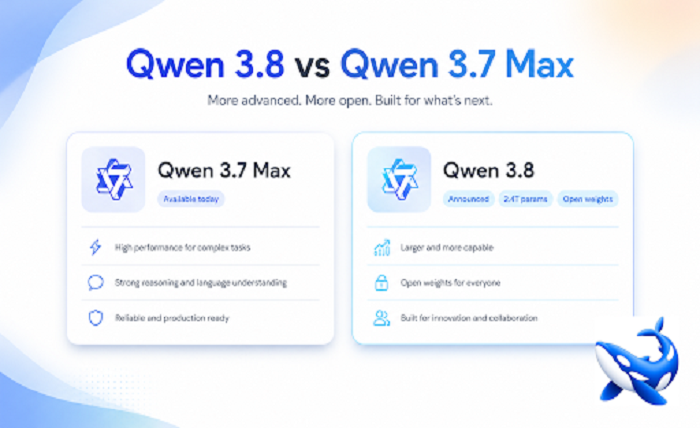
Every new flagship invites the same question from teams already using the previous one: is it worth switching? For Alibaba’s Qwen line, that question is now on the table, because the company announced its next flagship on July 19, 2026. The honest answer today is “we can’t fully know yet” — but we can lay out what’s confirmed, what’s claimed, and how the two models relate, so you can decide when the time comes.
The incoming model, Qwen 3.8, is the announced successor to Qwen 3.7 Max. Crucially, it is not yet generally available – only a hosted preview exists – while 3.7 Max is shippable today, and that asymmetry shapes the entire comparison. A practical way to straddle it is to keep both reachable behind one interface: a router like OrcaRouter fronts current models such as 3.7 Max now, and can add the newer flagship the day it opens up, so switching is a config change.
The one that’s available: Qwen 3.7 Max
Qwen 3.7 Max is Alibaba’s current Qwen flagship and the model you can actually build on right now. It’s a mature, generally available option with a real track record, and it’s the sensible default for any Qwen-based project today. If you need to ship this quarter, 3.7 Max — not 3.8 — is the model to design around.
The one that’s coming: Qwen 3.8
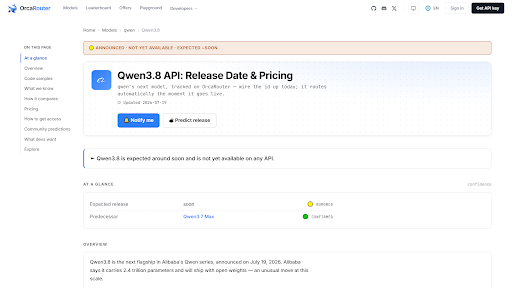
Qwen 3.8 is the announced next step. Per Alibaba, it carries a reported 2.4 trillion parameters and will ship with open weights — the headline changes over the previous generation. A hosted Qwen3.8-Max-Preview is running on Alibaba’s Token Plan, Qoder, and QoderWork, with the full open-weight release expected soon. What we don’t have yet: independent benchmarks, confirmed pricing, or a firm date.
What actually seems to be changing
Based on Alibaba’s statements, two shifts stand out. The first is scale and openness together: a 2.4T-parameter model released with open weights is a different proposition from a closed flagship — it enables self-hosting, fine-tuning, and data-resident deployment that a closed model can’t. The second is the strategic posture: shipping a preview on Alibaba’s own platforms ahead of an open release suggests a staged rollout. Beyond that, any claim about specific capability gains over 3.7 Max is speculation until independent testing exists. We won’t invent numbers.
How to decide between them
The decision is really about timing and needs. If you need to ship now, or you want a proven, generally available model, use Qwen 3.7 Max — it’s the only one of the two you can fully rely on today. If your use case specifically benefits from open weights at frontier scale (self-hosting, fine-tuning, compliance) and you can wait, Qwen 3.8 is worth tracking and testing the moment it’s live. For many teams the answer is “both, over time”: build on 3.7 Max now, and evaluate 3.8 when it ships.
Making the switch painless
Because both are accessible through an OpenAI-compatible interface, moving from 3.7 Max to 3.8 later should be close to a one-line change if you keep the model name configurable. OrcaRouter exposes Qwen 3.7 Max today and tracks Qwen 3.8, routing to it automatically once it launches — so you can build on the available model now and A/B test the new one against it the day it goes live, without a re-integration.
A clean migration plan, for when 3.8 is ready
Assuming Qwen 3.8 proves out, here’s a low-risk way to move from 3.7 Max without disrupting production. Start by keeping 3.7 Max as your stable default and adding 3.8 as a candidate behind the same OpenAI-compatible interface, with the model name in config. Next, shadow-test: mirror a copy of real production requests to 3.8 without serving its responses to users, and grade the results against 3.7 Max on your own rubric. If 3.8 wins on the metrics you care about — quality, latency, cost — begin a canary rollout, sending a small percentage of live traffic to it while watching error rates and tail latency. Ramp gradually, keeping 3.7 Max as an instant fallback if anything regresses.
This staged approach matters more than usual here because Qwen 3.8 will be new and, at least initially, less battle-tested than the mature 3.7 Max. A big model can win on paper and still surprise you on your specific traffic or edge cases. Shadow-testing and canarying surface those surprises before they reach users. And because both models sit behind the same interface, every step is a configuration change rather than a code change, so you can advance or roll back in seconds. The goal is to capture Qwen 3.8’s upside — potentially better capability and open-weight flexibility — without betting production stability on an unproven release. Patience in the migration is cheap; a botched cutover on a critical path is not.
Frequently asked questions
Is Qwen 3.8 better than Qwen 3.7 Max? Unknown, honestly — there are no independent benchmarks for 3.8 yet. It’s larger (a reported 2.4T params) and slated to be open-weight, but capability claims are unverified.
Which should I use today? Qwen 3.7 Max — it’s generally available and proven. Qwen 3.8 isn’t fully released yet.
What’s the biggest difference? Alibaba’s stated open-weight release at 2.4T scale, which enables self-hosting and fine-tuning in a way a closed flagship doesn’t.
Can I try Qwen 3.8 at all? Yes — a hosted Qwen3.8-Max-Preview runs on Alibaba’s platforms for an early feel.
How hard is it to switch later? With an OpenAI-compatible interface and a configurable model name, switching from 3.7 Max to 3.8 is typically a one-line change.
Bottom line
Qwen 3.7 Max is the flagship you can build on today; Qwen 3.8 is the announced successor whose big changes are scale (a reported 2.4T parameters) and an open-weight release, both still unproven by independent testing. Use 3.7 Max for anything shipping now, track 3.8 for its open-weight potential, and keep your integration model-agnostic so you can compare them head-to-head the moment 3.8 is live. Resist the urge to switch on reputation alone; let a shadow test on your own traffic decide whether the newer, larger, open-weight model actually beats the proven one for your specific workload before you move production over to it.