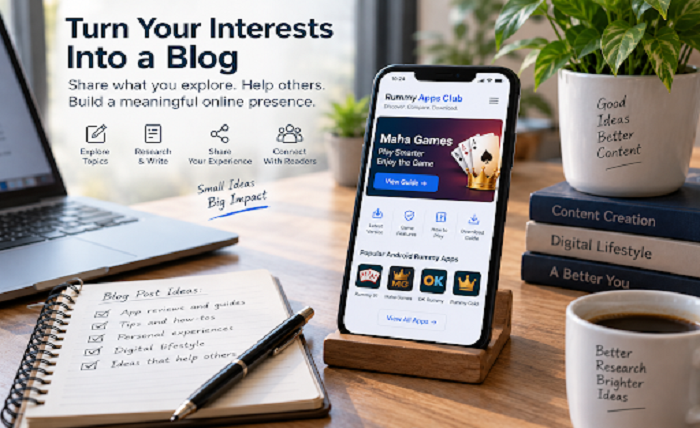
A social media bio introduces you in a few lines. A personal blog gives you room to explain the interests behind those lines.
Perhaps you enjoy finding unfamiliar music, exploring mobile applications, or discussing the design of digital games. Those interests can become subjects for useful articles, but simply naming a hobby is not enough. The more interesting question is what you have noticed about it.
You do not need to present yourself as an expert or turn your evenings into a content-production schedule. Start with a genuine question, investigate it carefully, and explain what you found in language you would use with a friend.
Here is a practical way to turn everyday digital interests into something worth publishing.
Find a Question Inside Your Hobby
Begin with a question rather than a broad category.
“Mobile entertainment” is a subject. “What information would I need before trying an unfamiliar entertainment app?” is an article idea. “Photography” is a hobby. “How did changing the crop affect this picture?” gives you something specific to explain.
Choose a question you can answer without pretending to know everything about the subject.
Think about the last time you compared two options, struggled to understand an instruction, or discovered a detail that changed your opinion. That moment may be a better starting point than a list of popular topics.
For a first article, keep the scope small. One clear question, answered properly, gives you a more manageable task than a complete guide to an entire industry.
Decide What the Reader Should Take Away
Before researching, finish this sentence: “After reading this article, someone should be able to…”
The answer might be identifying an unclear app description, organizing a playlist around a particular mood, or deciding which questions to ask before creating an account.
This gives the article a purpose beyond expressing enthusiasm.
For example, an adult-focused post about Android rummy apps could examine what readers should look for in application information before forming an opinion. The focus could be the clarity of instructions, the explanation of requirements, or the distinction between a directory entry and information supplied by an app operator.
You would not need to rank every application. You would need to show readers how to examine the information in front of them.
Keep that intended takeaway visible while drafting. Remove sections that do not help deliver it.
Keep a Small Research Notebook
Research becomes easier to organize when you separate different kinds of notes.
Record what a source says, what you have personally observed, and what remains unanswered. Do not combine them into one paragraph too early.
Suppose a description calls an interface straightforward. That is a published claim. Finding the rules section without difficulty is an observation you could make during a genuine test. Whether a new user would have the same experience remains a separate question.
Save the source and date beside each note. When information conflicts, record the disagreement rather than choosing whichever version sounds better.
This notebook does not need to become part of the published article. Its purpose is to keep your writing connected to the work you actually did.
Use One Concrete Example
A practical example gives you something specific to discuss.
Take Maha Games as a research topic rather than beginning with a recommendation. You could examine the information presented in its listing and identify which questions you would still want the relevant provider to answer.
Does the description explain the purpose of the application clearly? Which requirements need confirmation? Are you reading an informational overview, an operator statement, or a firsthand review?
The article can explain that process without making unsupported claims about the application.
Use the example to demonstrate your method, then return to the broader lesson. There is no need to repeat the product name throughout the article or turn every paragraph into a reason to try it.
Describe Experience at the Right Level
Be precise about how you know something.
Reading a listing, watching a demonstration, installing an application, and using it over time are different activities. Write sentences that reflect the activity you actually completed.
For example, “The description mentions an account-verification step” reports published information. “During my test, the verification message arrived after two minutes” describes a specific experience and should only appear when that test genuinely happened.
Do not stretch a small observation into a universal conclusion. One successful attempt does not justify a claim that a feature always works. Equally, an unresolved question does not establish that something is defective.
You can publish useful research without calling it a review. Choose a label that matches the evidence you have.
Build the Article Around a Simple Sequence
Give the reader a clear route through the subject.
Start by explaining the question. Introduce the information you examined. Show the detail that mattered, discuss any limitations, and finish with a practical takeaway.
For an article about app information, this might mean moving from a category overview to an individual listing, then distinguishing documented details from unresolved questions.
For a music article, the sequence could move from the mood you wanted to create to the tracks you considered and the choices you made.
Avoid adding a section merely because it appears in other articles. A generic prediction about “the future of digital entertainment” will not improve a piece whose real purpose is to explain one everyday decision.
Make Visuals Explain Something
Choose images that support the question you are answering.
A screenshot may help illustrate a navigation issue. A close crop can show a design detail. A photograph of your notes may suit an article about how you organize research.
Give each visual a job. Explain what the reader should notice instead of adding a decorative image between every heading.
Before publishing screenshots, inspect them for private messages, email addresses, account identifiers, and notification previews. Obtain permission before including someone else’s private conversation or personal information.
Also distinguish a mockup from an actual interface. An illustration can explain an idea, but it should not be presented as evidence of what an application really displays.
Keep Your Voice Without Turning the Article Into a Pitch
Use your own observations to give the writing personality.
Explain why a question interested you, where the information became confusing, or which detail deserved more attention. Those points are more informative than repeatedly calling something impressive, innovative, or essential.
When including a resource, explain its role. Is it a directory you consulted, an individual information page, or documentation that answers a specific question?
Leave readers room to decide what to do next. Researching a product does not create an obligation to install it, register, or make a purchase.
Keep coverage of age-restricted entertainment directed at adults. Do not present paid participation as an income opportunity or encourage readers to disregard restrictions.
Finish With What You Actually Learned
Return to the question that started the article.
Summarize the useful finding, identify anything still unresolved, and stop there. You do not need an exaggerated verdict or a prediction about an entire industry.
A personal blog can be a record of careful curiosity: what you examined, what you understood, and what you are still trying to establish.
Start with one subject you genuinely care about. Ask a question small enough to investigate. Keep the evidence and your interpretation separate. Then write the explanation you would have appreciated before beginning your own research.
That is a solid foundation for an article—and for a blog with a voice of its own.