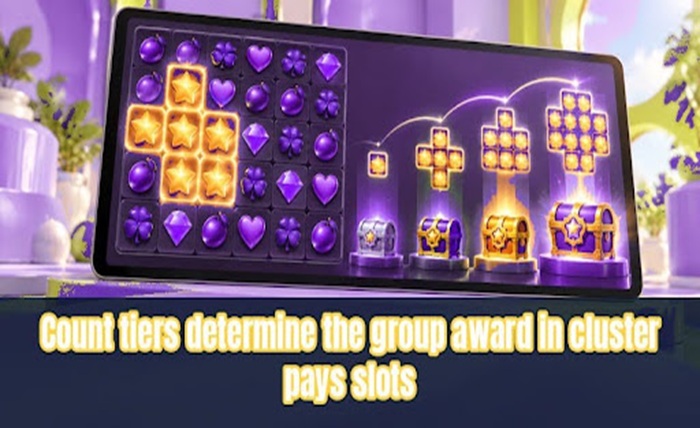
Cluster pays slots organize matching positions through a connection rule instead of a listed reel path. A diagonal touch can be excluded while a horizontal edge qualifies, depending on the title. The nohu90 reader’s first task is therefore a membership map, followed by the correct count tier. Once that is clear, removal, refill and special symbols can be followed without turning every visible neighboring icon into another award.
Count Tiers In Cluster Pays Slots Awards
At nohu90 com , The qualifying group size selects a cluster pays slots count tier. Count the group before applying special symbol or multiplier behavior.
Count A Qualifying Group
Suppose a fictional rule pays a group of seven blue symbols at three times the total bet. Cluster pays slots with a 0.50 total bet would pay 1.50 for that group under the stated example. A separate six symbol group needs its own table tier. The illustration does not imply that blue pays the same amount in a real title, or that all group awards use total bet units.
Apply The Relevant Paytable Tier
A table can use count bands such as five to six, seven to nine and ten or more. Read the applicable band once rather than summing every lower band crossed by the group. If a group of eight belongs to the seven to nine tier, apply that tier’s payment. Some special designs calculate values differently, so the displayed symbol count and its actual formula should remain together in a record.
Draw an illustrative group of six matching symbols joined only through horizontal or vertical neighbors. Add a seventh matching symbol touching the group diagonally but sharing no permitted edge. Under the stated edge only rule, the group remains six rather than seven. A separate group of five is evaluated separately if its positions do not connect to the first. This boundary test keeps count bands accurate. If the fictional six symbol tier pays two times total bet at 0.40, its amount is 0.80, independently of any other qualifying group.
Count tiers should be checked against the exact group size. A fictional table might pay one amount for five symbols and a larger amount for six through eight, while a group of four receives nothing. In that example, a sixth eligible member changes the tier rather than automatically creating a second five symbol award. Some instructions group sizes into ranges; others list each count. Read the chosen table entry in its own payment unit. A bright patch covering much of the screen can still be below the minimum if its apparent members are separated by positions the adjacency rule excludes.
Read Wild And Multiplier Interactions
Wilds can join eligible groups under the stated rule, while multipliers can affect a group or wider payment scope. If one wild could qualify with different symbol groups, the game’s evaluation order or best award convention matters. Avoid counting the same special position twice without permission. A multiplier label also needs its scope; it may apply only when that wild participates in the paid group.
Removal, Refill And Another Evaluation
A paid group can initiate another evaluation in cluster pays slots. Follow the particular cycle instead of assuming every title uses the same cascade.
Follow Removal And Refill Rules
Some games remove only paying group symbols; others can also remove additional instances or create special symbols. Cluster pays slots need the written removal rule to explain why a refill grid looks different. Remaining symbols can fall or stay according to the layout system. A paid group’s replacement does not mean every symbol on the screen is redrawn, nor guarantee another qualifying group.
Removal adds a new state rather than rewriting the membership of an earlier paid group. After eligible positions disappear, the remaining symbols can fall or be replaced according to the refill rule. Only the resulting grid receives the next connection test. A symbol that belonged to the first group may therefore be absent when the second forms. If multipliers persist across steps, record their current values at evaluation time. The sequence ends under its actual stop condition. Counting each completed award once keeps the total intelligible even when several new groups appear during a single paid initiation.
Track A Changing Group Size
A later refill can join previously separate symbols into a larger group, but the new arrangement needs fresh evaluation. Count its connections and table tier again. If a multiplier grows during the cycle, record the new value with that step rather than applying it retroactively to earlier awards. A running total can summarize several actual payments inside one original paid round.
Keep One Paid Round Together
One paid initiation may produce several evaluated groups, so an nohu90 ledger should connect the complete cascade award to that original cost. A refill without a new paid initiation does not create another stake in the ledger. Separate feature counters from credits, and read where the cycle stops or changes mode. An enlarged group can be exciting without predicting the next refill’s result or establish that the title is more profitable than a line game.
The Connection Test For Cluster Pays Slots
Adjacency determines which positions belong together in cluster pays slots. Identify which neighboring positions connect before deciding whether separate symbols form one group.
Locate The Adjacency Rule
Many designs use horizontal and vertical connections, but the actual title can specify another rule. Cluster pays slots should not automatically count diagonal touching positions as joined. Draw a small grid and follow only permitted edges between matching symbols. A visually close symbol can still be outside the qualifying group. The connection rule determines the membership before the group size is compared with the paytable.
Connection rules decide whether a group contains a borderline position. Draw a small fictional patch with four matching symbols linked through shared edges and a fifth touching only at a corner. Under an edge only rule the fifth is excluded; under an explicitly diagonal connection rule it may join. Neither interpretation can be selected because it produces the larger payment. Mark the eligible links first, count the resulting membership, then find the applicable threshold. Two nearby patches of the same color also need their own membership test before being treated as one group, particularly when a different symbol separates them.
Check The Minimum Group Size
The minimum qualifying count depends on the game and sometimes the symbol or feature mode. A familiar five symbol threshold is not universal. Find the minimum in the installed instructions and record it beside the symbol identity. A group below that threshold can be visible and connected without paying. The graphic’s size or brightness cannot substitute for a rule about which count begins an award.
Distinguish Separate Groups
Two groups separated by a gap or another symbol can remain distinct. Do not combine them merely because their symbols match. A game may evaluate and pay each qualifying group separately, or have a special merging rule after a cascade. Read that treatment explicitly. The same grid can contain one large group, several separate paid groups or connected groups that remain too small to qualify.
Conclusion
Cluster pays slots use eligible connections and minimum group size to decide which count tier applies. After membership is established, the table and stake unit determine the actual amount. In an https://nohu.shiksha/ example, draw a group with one borderline diagonal symbol, test its eligibility and calculate its applicable tier. Then follow only the stated removal cycle and sum completed payments once. A visually large patch can be informative without a universal connection rule or a guarantee that its next refill will pay.