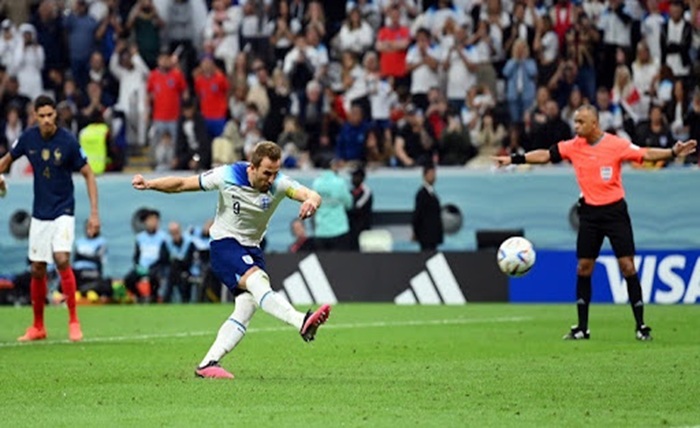
In the emotional world of football, there are terms that fans often use interchangeably during casual discussions. One of the most common sources of confusion is between “penalty” (penalty kick) and “penalty shootout.” Most television viewers assume they are the same thing, but under the international Laws of the Game established by IFAB, these are two completely different situations in terms of when they occur, their legal nature, and their purpose in deciding a match.
Let’s step into the world of football and clarify the question of how penalty shootouts and penalties differ through the detailed article below.
What is a penalty?
To understand the key difference, the first step is to grasp the nature of a penalty kick during a regular football match.
A penalty, also known as an 11-meter penalty kick, is a direct punishment awarded by the referee during regular playing time or extra time. This situation occurs when a defending player commits a serious foul against an opposing attacking player, such as tripping, pushing, or illegally obstructing them, or deliberately handles the ball inside their own penalty area (the 16.5-meter box).
When the offense occurs, the referee blows the whistle to stop play and points directly to the white spot exactly 11 meters from the goal line. The attacking player then has a one-on-one opportunity against the opposing goalkeeper under the intense expectations of thousands of spectators in the stadium. This is an integral part of normal match proceedings.
To closely follow major matches and avoid missing thrilling penalty decisions in major games, many fans regularly visit Xoilac 86 to enjoy smooth, high-definition streaming and a complete entertainment experience.
What is a penalty shootout?
Unlike a penalty kick, which can occur at any point during the 90 minutes of a match, a penalty shootout has a completely different nature and purpose.
A penalty shootout, commonly referred to as an 11-meter shootout, is not a punishment for an offense during the match. Instead, it is a final method of determining the winner when two teams remain level after regular time and two periods of extra time, typically in knockout matches such as the Champions League final, the World Cup, or continental championship competitions.
Key characteristics of a penalty shootout include:
- When it takes place: It occurs after the final whistle has ended 120 minutes of football with the score still level.
- Format: Each team takes turns selecting players to take penalty kicks from the 11-meter spot. Initially, each team has five attempts. If the score remains level after those five attempts, the shootout proceeds to sudden death until one team scores more than the other after an equal number of kicks.
Penalty shootouts are always among the most dramatic moments in football, where mental strength, psychological pressure, and a little luck can completely determine the fate of an entire team.
When European cup matches take place late at night, if viewers cannot stay awake to watch the full 120 minutes of tension, they often choose to watch highlight bóng đá Ngoại hạng Anh videos or cup matches on the Xôi Lạc 86 system to quickly catch breathtaking shootouts and explosive emotional moment
Key differences between a penalty shootout and a penalty
To make the distinction easier to understand and remember, we can summarize the differences between these two concepts according to several specific criteria:
- When they occur: A penalty can be awarded at any point during live play in regular 90-minute time or extra time, while a penalty shootout takes place only after a knockout match has ended in a draw.
- Purpose: A penalty is a punishment for an offense inside the penalty area, whereas a penalty shootout is a procedure used to determine which team advances or wins the championship.
- Number of opportunities: A penalty involves a single kick resulting from a specific foul, while a penalty shootout consists of a series of consecutive kicks, initially with five attempts for each team.
Clearly distinguishing these concepts helps us use football terminology correctly when discussing major matches.
To avoid missing the latest sports news, detailed schedules, and in-depth analysis of the Laws of the Game, the football community always prefers to follow reputable information channels from Link Xoilac. The platform’s convenience and stability make it easy for viewers to stay connected to their passion for the beautiful game anytime, anywhere.
Conclusion
Understanding how penalty shootouts and penalties differ helps us better appreciate the subtle details of the Laws of the Game. Whether it is a nerve-wracking penalty during a match or a tense shootout at the end of a game, both situations create unforgettable emotional moments for millions of football fans around the world